Bauhaus
History of the Bauhaus
Weimar
Staatliches Bauhaus, commonly known simply as Bauhaus, was a German art school operational from 1919 to 1933 that combined crafts and the fine arts, and was famous for the approach to design that it publicised and taught.
Weimar
The school was founded by Walter Gropius in Weimar in 1919 as a merger of the Grand Ducal School of Arts and Crafts and the Weimar Academy of Fine Art. Its roots lay in the arts and crafts school founded by the Grand Duke of Saxe-Weimar-Eisenach in 1906 and directed by Belgian Art Nouveau architect Henry van de Velde.[10] When van de Velde was forced to resign in 1915 because he was Belgian, he suggested Gropius, Hermann Obrist and August Endell as possible successors. In 1919, after delays caused by the destruction of World War I and a lengthy debate over who should head the institution and the socio-economic meanings of a reconciliation of the fine arts and the applied arts (an issue which remained a defining one throughout the school's existence), Gropius was made the director of a new institution integrating the two called the Bauhaus.[11] In the pamphlet for an April 1919 exhibition entitled "Exhibition of Unknown Architects", Gropius proclaimed his goal as being "to create a new guild of craftsmen, without the class distinctions which raise an arrogant barrier between craftsman and artist." Gropius' neologism Bauhaus references both building and the Bauhütte, a premodern guild of stonemasons.[12] The early intention was for the Bauhaus to be a combined architecture school, crafts school, and academy of the arts. In 1919 Swiss painter Johannes Itten, German-American painter Lyonel Feininger, and German sculptor Gerhard Marcks, along with Gropius, comprised the faculty of the Bauhaus. By the following year their ranks had grown to include German painter, sculptor and designer Oskar Schlemmer who headed the theater workshop, and Swiss painter Paul Klee, joined in 1922 by Russian painter Wassily Kandinsky. A tumultuous year at the Bauhaus, 1922 also saw the move of Dutch painter Theo van Doesburg to Weimar to promote De Stijl ("The Style"), and a visit to the Bauhaus by Russian Constructivist artist and architect El Lissitzky.[13]
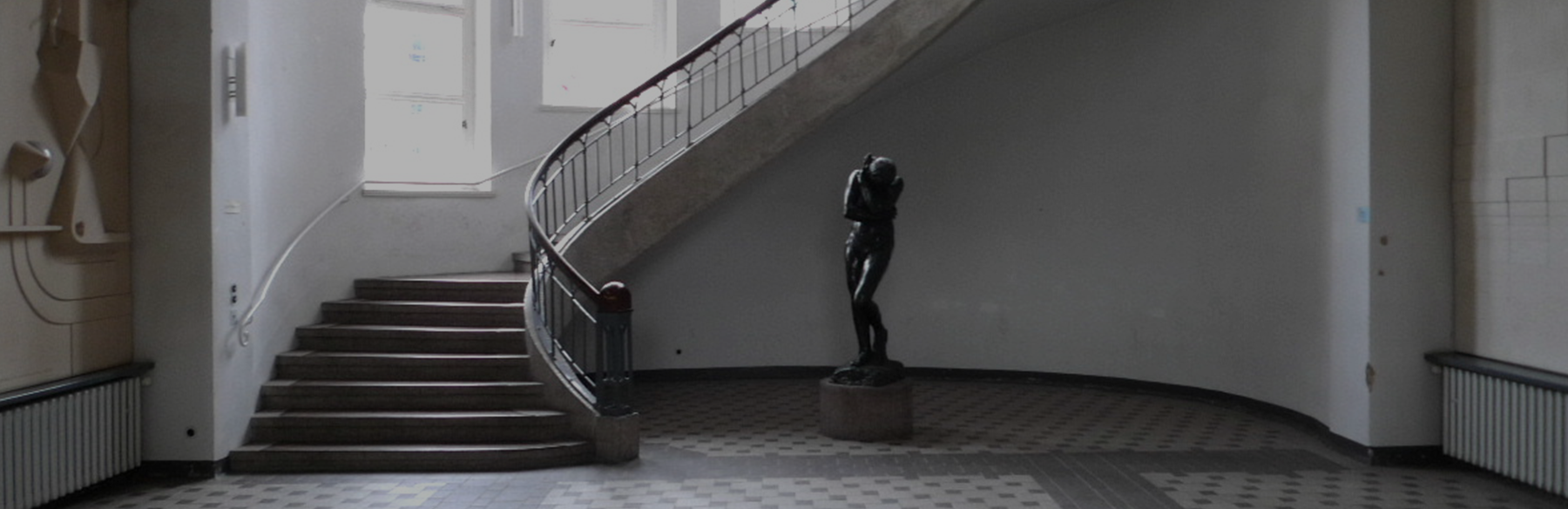
The main building of the Bauhaus-University Weimar (built 1904–1911, designed by Henry van de Velde to house the sculptors’ studio at the Grand Ducal Saxon Art School. Designated as a UNESCO World Heritage Site in 1996). Foyer of the Bauhaus-University Weimar with Jugendstil staircase
From 1919 to 1922 the school was shaped by the pedagogical and aesthetic ideas of Johannes Itten, who taught the Vorkurs or "preliminary course" that was the introduction to the ideas of the Bauhaus.[11] Itten was heavily influenced in his teaching by the ideas of Franz Cižek and Friedrich Wilhelm August Fröbel. He was also influenced in respect to aesthetics by the work of the Blaue Reiter group in Munich as well as the work of Austrian Expressionist Oskar Kokoschka. The influence of German Expressionism favoured by Itten was analogous in some ways to the fine arts side of the ongoing debate. This influence culminated with the addition of Der Blaue Reiter founding member Wassily Kandinsky to the faculty and ended when Itten resigned in late 1922. Itten was replaced by the Hungarian designer László Moholy-Nagy, who rewrote the Vorkurs with a leaning towards the New Objectivity favored by Gropius, which was analogous in some ways to the applied arts side of the debate. Although this shift was an important one, it did not represent a radical break from the past so much as a small step in a broader, more gradual socio-economic movement that had been going on at least since 1907 when van de Velde had argued for a craft basis for design while Hermann Muthesius had begun implementing industrial prototypes.[13]
Gropius was not necessarily against Expressionism, and in fact himself in the same 1919 pamphlet proclaiming this "new guild of craftsmen, without the class snobbery," described "painting and sculpture rising to heaven out of the hands of a million craftsmen, the crystal symbol of the new faith of the future." By 1923 however, Gropius was no longer evoking images of soaring Romanesque cathedrals and the craft-driven aesthetic of the "Völkisch movement", instead declaring "we want an architecture adapted to our world of machines, radios and fast cars."[14] Gropius argued that a new period of history had begun with the end of the war. He wanted to create a new architectural style to reflect this new era. His style in architecture and consumer goods was to be functional, cheap and consistent with mass production. To these ends, Gropius wanted to reunite art and craft to arrive at high-end functional products with artistic merit. The Bauhaus issued a magazine called Bauhaus and a series of books called "Bauhausbücher". Since the Weimar Republic lacked the quantity of raw materials available to the United States and Great Britain, it had to rely on the proficiency of a skilled labor force and an ability to export innovative and high quality goods. Therefore, designers were needed and so was a new type of art education. The school's philosophy stated that the artist should be trained to work with the industry.[15][16]
Weimar was in the German state of Thuringia, and the Bauhaus school received state support from the Social Democrat-controlled Thuringian state government. The school in Weimar experienced political pressure from conservative circles in Thuringian politics, increasingly so after 1923 as political tension rose. One condition placed on the Bauhaus in this new political environment was the exhibition of work undertaken at the school. This condition was met in 1923 with the Bauhaus' exhibition of the experimental Haus am Horn.[17] In February 1924, the Social Democrats lost control of the state parliament to the Nationalists.[citation needed] The Ministry of Education placed the staff on six-month contracts and cut the school's funding in half. On 26 December 1924 the Bauhaus issued a press release and setting the closure of the school for the end of March 1925.[18][19] At this point they had already been looking for alternative sources of funding. After the Bauhaus moved to Dessau, a school of industrial design with teachers and staff less antagonistic to the conservative political regime remained in Weimar. This school was eventually known as the Technical University of Architecture and Civil Engineering, and in 1996 changed its name to Bauhaus-University Weimar.
Dessau
Gropius's design for the Dessau facilities was a return to the futuristic Gropius of 1914 that had more in common with the International style lines of the Fagus Factory than the stripped down Neo-classical of the Werkbund pavilion or the Völkisch Sommerfeld House.[20] During the Dessau years, there was a remarkable change in direction for the school. According to Elaine Hoffman, Gropius had approached the Dutch architect Mart Stam to run the newly founded architecture program, and when Stam declined the position, Gropius turned to Stam's friend and colleague in the ABC group, Hannes Meyer.
Meyer became director when Gropius resigned in February 1928, and brought the Bauhaus its two most significant building commissions, both of which still exist: five apartment buildings in the city of Dessau, and the Bundesschule des Allgemeinen Deutschen Gewerkschaftsbundes (ADGB Trade Union School) in Bernau bei Berlin. Meyer favored measurements and calculations in his presentations to clients, along with the use of off-the-shelf architectural components to reduce costs. This approach proved attractive to potential clients. The school turned its first profit under his leadership in 1929.
But Meyer also generated a great deal of conflict. As a radical functionalist, he had no patience with the aesthetic program, and forced the resignations of Herbert Bayer, Marcel Breuer, and other long-time instructors. Even though Meyer shifted the orientation of the school further to the left than it had been under Gropius, he didn't want the school to become a tool of left-wing party politics. He prevented the formation of a student communist cell, and in the increasingly dangerous political atmosphere, this became a threat to the existence of the Dessau school. Dessau mayor Fritz Hesse fired him in the summer of 1930.[21] The Dessau city council attempted to convince Gropius to return as head of the school, but Gropius instead suggested Ludwig Mies van der Rohe. Mies was appointed in 1930, and immediately interviewed each student, dismissing those that he deemed uncommitted. Mies halted the school's manufacture of goods so that the school could focus on teaching. Mies appointed no new faculty other than his close confidant Lilly Reich. By 1931, the National Socialist German Workers' Party (Nazi Party) was becoming more influential in German politics. When they gained control of the Dessau City Council they moved to close the school.
Berlin
In late 1932, Mies rented a derelict factory in Berlin to use as the new Bauhaus with his own money. The students and faculty rehabilitated the building, painting the interior white. The school operated for ten months without further interference from the Nazi Party. In 1933, the Gestapo closed down the Berlin school. Mies protested the decision, eventually speaking to the head of the Gestapo, who agreed to allow the school to re-open. However, shortly after receiving a letter permitting the opening of the Bauhaus, Mies and the other faculty agreed to voluntarily shut down the school.[22]
Although neither the Nazi Party nor Adolf Hitler had a cohesive architectural policy before they came to power in 1933, Nazi writers like Wilhelm Frick and Alfred Rosenberg had already labeled the Bauhaus "un-German" and criticized its modernist styles, deliberately generating public controversy over issues like flat roofs. Increasingly through the early 1930s, they characterized the Bauhaus as a front for communists and social liberals. Indeed, a number of communist students loyal to Meyer moved to the Soviet Union when he was fired in 1930.
Even before the Nazis came to power, political pressure on Bauhaus had increased. The Nazi movement, from nearly the start, denounced the Bauhaus for its "degenerate art", and the Nazi regime was determined to crack down on what it saw as the foreign, probably Jewish influences of "cosmopolitan modernism". Despite Gropius's protestations that as a war veteran and a patriot his work had no subversive political intent, the Berlin Bauhaus was pressured to close in April 1933. Emigrants did succeed, however, in spreading the concepts of the Bauhaus to other countries, including the “New Bauhaus” of Chicago:[23] Mies decided to emigrate to the United States for the directorship of the School of Architecture at the Armour Institute (now Illinois Institute of Technology) in Chicago and to seek building commissions.[a] The simple engineering-oriented functionalism of stripped-down modernism, however, did lead to some Bauhaus influences living on in Nazi Germany. When Hitler's chief engineer, Fritz Todt, began opening the new autobahn (highways) in 1935, many of the bridges and service stations were "bold examples of modernism"—among those submitting designs was Mies van der Rohe.[24]